A clearer handoff between people and coding agents.
I built Day Shift to let coding agents carry scoped software work across sessions, with shared context beside the code and a human in charge of what ships. Its local browser workspace and CLI connect specifications, implementation handoffs, and review evidence; tnsds.tech makes the product available to evaluate and download.
Designed a human-agent contract: templated Markdown specifications with lightweight metadata let agents discover relevant context and continue work across sessions without relying on chat history.
Built agent-facing CLI commands for discovery, readiness checks, review, and artifact updates, returning JSON next-step guidance based on workflow state.
Defined human approval boundaries: agents are instructed to stop and ask before expanding scope, and accepting completed work remains a separate human decision.
Used Day Shift in its own development: as of October 2026, planning records document 119 completed phases covering 1,162 tasks with implementation summaries. Progressed from supervising tasks to milestones and full phases, followed by my code review and user testing.
Used Codex and GitHub Copilot with Day Shift. Kept shared workflow context in local project artifacts, with prompts and selected context sent to configured remote inference providers.
I built tnsds.tech to introduce the product and connect the walkthrough, proof records, downloads, and licensing information.
I created the supporting documentation and example workflows that let people evaluate the product and understand its boundaries.
DAY SHIFT / PLAN · GUIDE · REVIEW
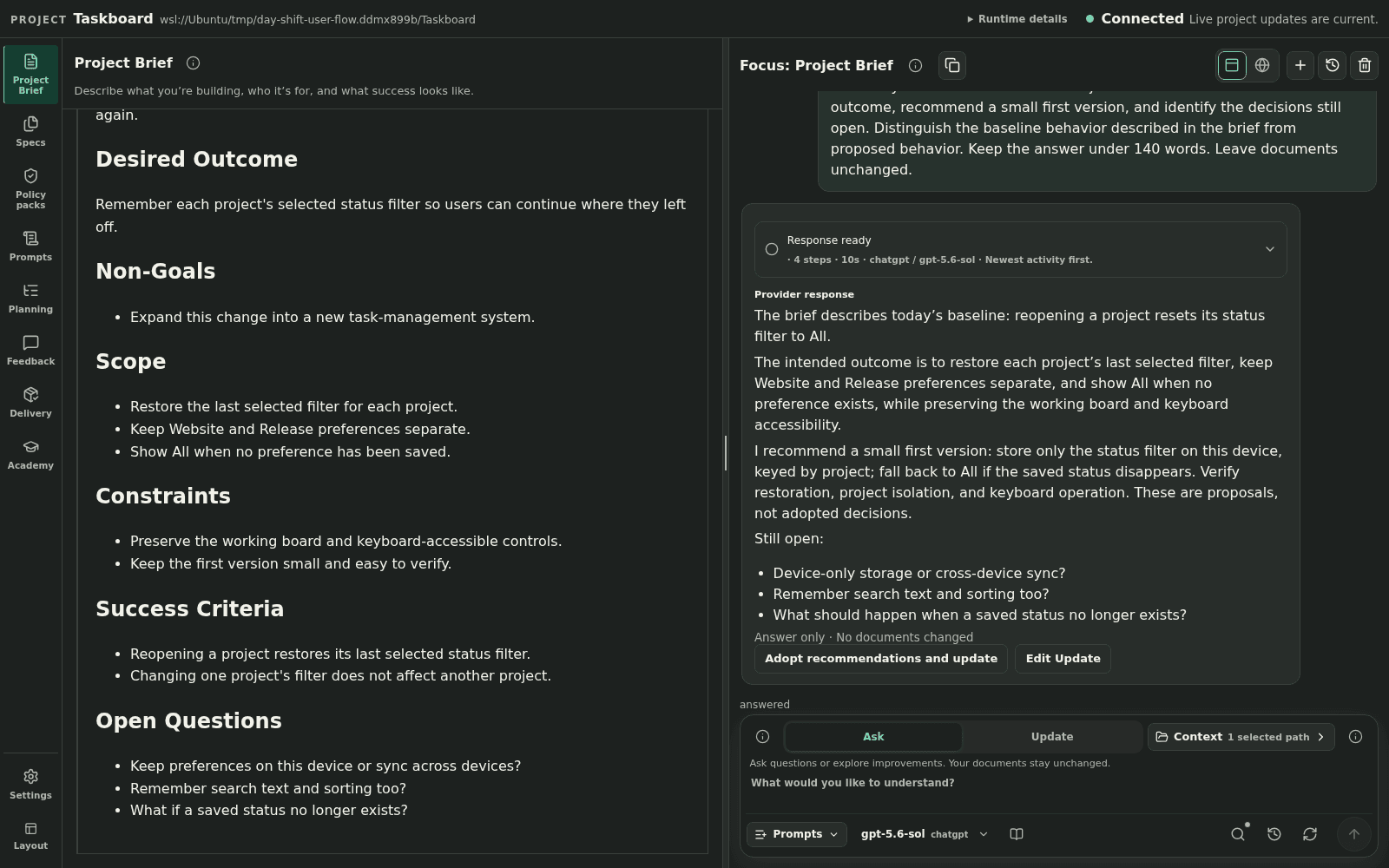
Day Shift · Project Brief
LOCAL WORKSPACE / GUI + CLITNSDS.TECH
Day Shift Project Brief and project-aware chat. Taskboard example · September 12, 2026 · development build. View source (opens in a new tab) ↗
01 / The challenge
Carry the work beyond the conversation.
Coding-agent work can spread decisions across chat, terminal output, and memory. When a session ends, the next person has to reconstruct the plan. The challenge is to keep intent, implementation context, and evidence together while keeping engineering judgment with the person responsible for the result.
02 / Design & engineering
The decisions that shape the system.
01
Keep the work beside the code
The browser workspace and CLI use local project artifacts for specifications, scoped tasks, and implementation summaries. That gives people and agents a continuation point across sessions. Configured remote inference providers receive prompts and selected project context.
02
Make the next step understandable
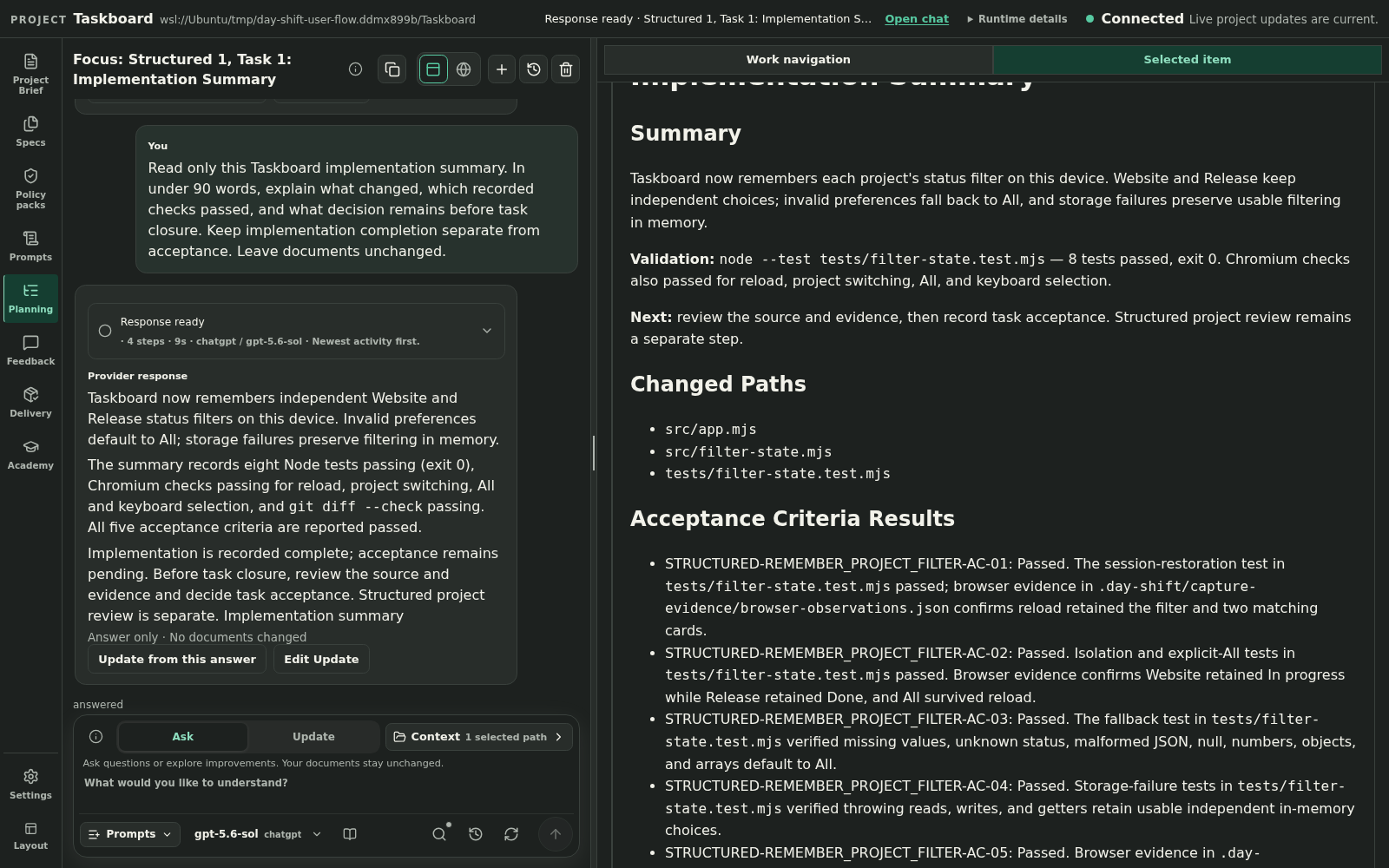
The experience follows a visible progression: clarify an idea, prepare work, hand it to a coding agent, then review the returned evidence. Planning and review remain distinct from accepting completed work.
03
Apply the workflow beyond Day Shift itself
At Atlas Networks, I used Day Shift to build the foundation and initial monitoring workflows for a network monitoring system. I deployed development and staging environments on a virtual machine and implemented ping-based device health checks with graphs of their history. The application remained in development when my role ended.
04
Let people evaluate the product
The public website brings an interactive walkthrough, proof records, documentation, and downloads into the evaluation path. Visitors can inspect how the workflow behaves before choosing to use it.
Reviewing returned work alongside its evidence. Taskboard example · September 12, 2026 · development build. Open full-size image ↗
03 / Delivery & direction
What you can inspect today.
Day Shift is publicly available with a browser GUI and CLI. tnsds.tech provides the product introduction, interactive demo, proof records, downloads, and commercial licensing information, while docs.tnsds.tech hosts the reusable product guidance.
Continuing direction
The continuing design focus is a legible path from an initial idea to reviewed work: preserve scope, show evidence in context, and keep the person responsible for acceptance in control.